In the typical heavy industrial bulk material handling scenario of cement production, grab buckets are the core tool for material handling, and their selection and use directly affect production efficiency, cost, and safety.
Cement Plant Operating Conditions and Grab Bucket Requirements
Material Characteristics:
Various Types: Limestone, clay, sandstone (raw materials), clinker, gypsum, blended materials (such as slag, fly ash), coal, etc.
Various Properties: From large, hard limestone blocks to finely powdered fly ash, materials vary greatly in bulk density, particle size, flowability, and abrasiveness.
High Abrasiveness: Especially clinker and limestone, causing extremely severe wear on the grab bucket body and cutting edge.
High Temperature: The temperature of clinker exiting the kiln can reach over 100℃, or even higher.
High Dust Levels: High dust concentration in the working environment.
Process Flow and Handling Points:
Raw Material Stockpile/Pre-homogenization Stockpile: Loading, unloading, mixing, and material removal.
Production Line Transfer Points: From crushed material to raw material mill, from clinker silo to cement mill, etc.
Unloading from Ships/Cars: Unloading at ports or railways.
Finished/Semi-finished Product Warehouses: Transferring, homogenizing, and loading materials from clinker silos, mixed material silos, and cement silos.
Common Grab Bucket Types and Selection Recommendations for Cement Plants
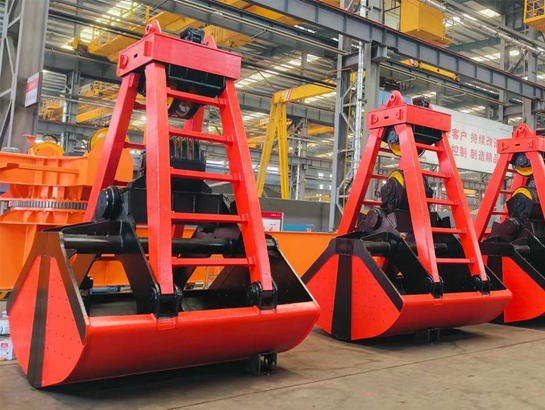
1. Clamshell Grab Bucket (Most Commonly Used)
Applicable Materials: Limestone, clay, clinker, lump coal, slag, and other medium-sized, moderately free-flowing bulk materials.
Selection Points:
Structural Reinforcement: Heavy-duty or extra-heavy-duty working class (A6-A8) grab buckets must be selected to withstand frequent operation and impacts.
Material and Wear Resistance:
Bucket Body: High-strength wear-resistant steel plate (such as Hardox series).
Cutting Edge: Must be equipped with replaceable high-manganese steel or alloy wear-resistant cutting edges; this is crucial for resisting wear from clinker and limestone.
Pulleys and Pins: Require hardening treatment and dustproof seals.
Dustproof Design: Pulley blocks should have protective covers, and moving joints should have dustproof rings to reduce wear caused by dust intrusion.
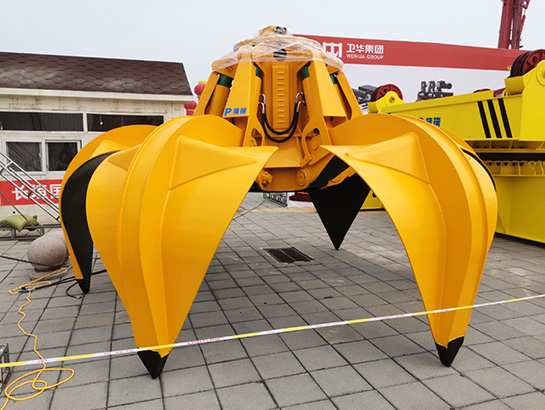
2. Multi-lobed Grab Bucket (Orange peel grabber)
Applicable Materials: Scrap steel, large irregular materials. Primarily used in cement plants to handle maintenance waste, large debris, or to process materials containing large pieces in raw material yards.
Selection Considerations: Less commonly used in the main process of cement plants, mainly as an auxiliary tool. A robust structure and tight closure are required.
3. Electro-hydraulic Grab Bucket (High-efficiency, Controllable Option)
Advantages:
No Auxiliary Wire Rope Required: Opening and closing are completed by a built-in motor-hydraulic system; single-rope lifting is sufficient, simplifying the crane structure.
Controllable Opening: Can be opened and closed at any position, facilitating the grabbing of thin layers of material and cleaning operations.
High gripping force: Provides a continuous and powerful closing force, effectively gripping compacted materials and hard lumps.
Applicable scenarios:
Applications requiring high airtightness (e.g., preventing powder spillage).
Processes requiring precise control of gripping volume.
Crane originally designed with a single hook, or where a simplified wire rope system is desired.
Selection considerations: Heat resistance and heat dissipation performance must be carefully considered. When gripping hot clinker, a model with high-temperature protection should be selected. The motor and hydraulic system should have special designs or heat insulation measures.