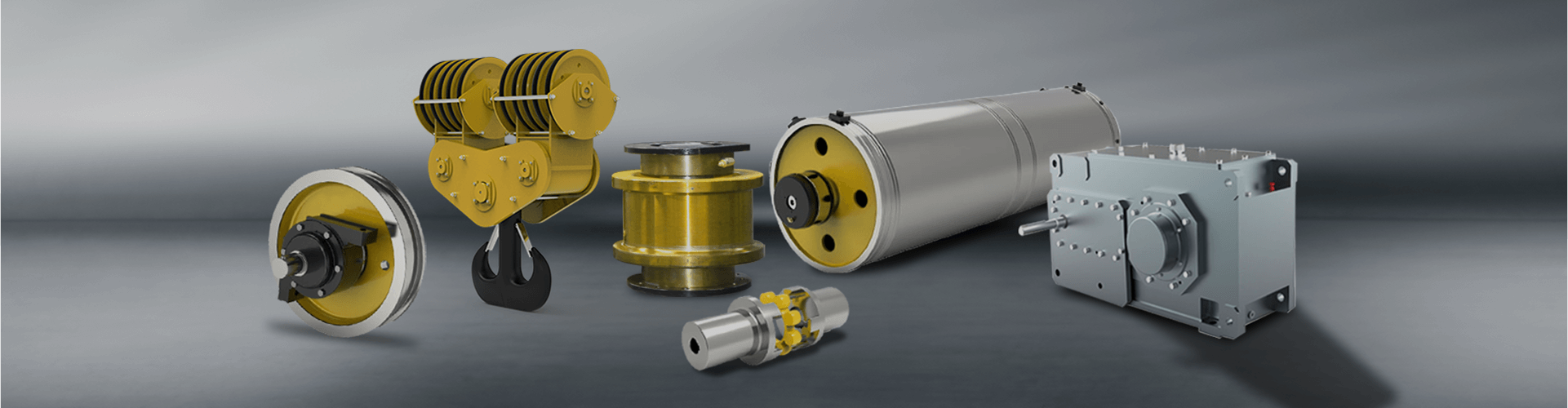
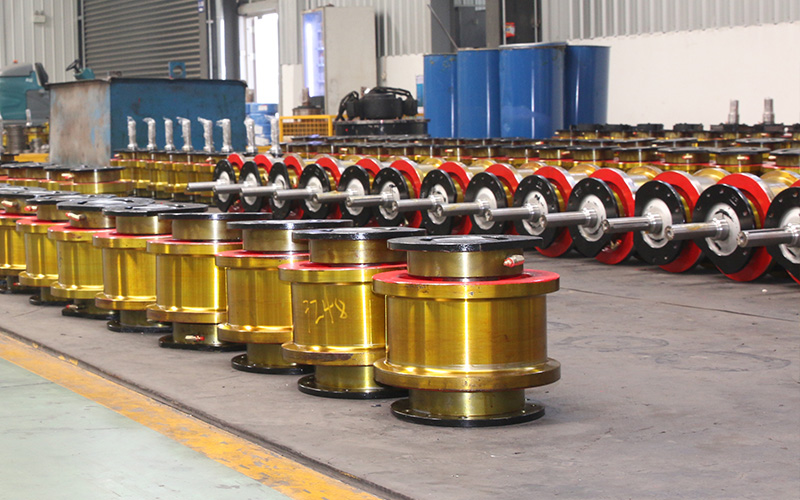
The wheels of a bridge crane are mainly installed on:
Crane Trolley Wheels: Installed at both ends of the crane's end beams (or counterweight beams), driving the crane longitudinally along the factory rails.
Crane Auxiliary Trolley Wheels: Installed on the trolley frame, driving the trolley carrying the load laterally along the rails on the main beam.
Core Function: While bearing the crane's own weight and lifting load (vertical force), they provide the necessary traction force (horizontal force) through friction with the rails, ensuring smooth, low-resistance, and reliable movement.
Classification by Wheel Material:
Forged Steel Wheels:
Material: Typically high-quality carbon steel or alloy steel such as 60# or 65Mn.
Features: High strength, good wear resistance, and high load-bearing capacity. The internal structure is dense due to forging.
Applications: The mainstream choice for medium and heavy-duty cranes.
Alloy Cast Steel Wheels:
Material: Such as ZG340-640.
Features: Complex shapes can be obtained through casting, with good overall mechanical properties.
Applications: Suitable for cranes of various specifications.
Ductile iron wheels:
Materials: QT600-3, QT700-2, etc.
Features: Good wear resistance and shock absorption, and relatively low cost. However, its impact resistance is slightly weaker than forged steel.
Applications: Commonly used in light and medium-sized cranes with low operating speeds.
Although the wheels of a bridge crane may seem like simple "wheels," their design, manufacture, installation, and maintenance involve profound mechanical principles and engineering practices, forming the cornerstone of ensuring the safe and stable operation of bridge cranes.
Although the
wheels of a bridge crane may seem like simple "wheels," their design, manufacture, installation, and maintenance involve profound mechanical principles and engineering practices, forming the cornerstone of ensuring the safe and stable operation of bridge cranes.