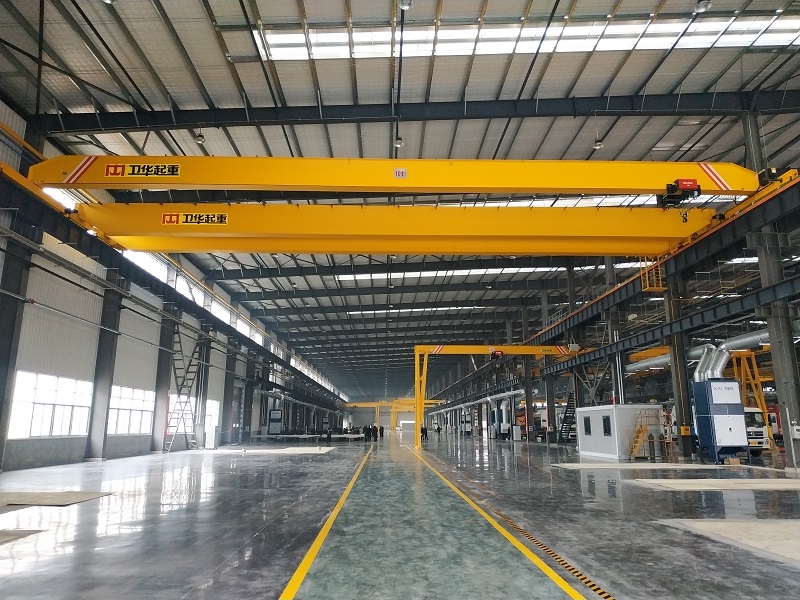
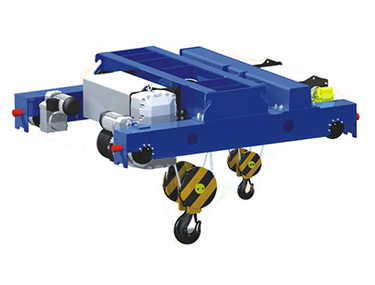
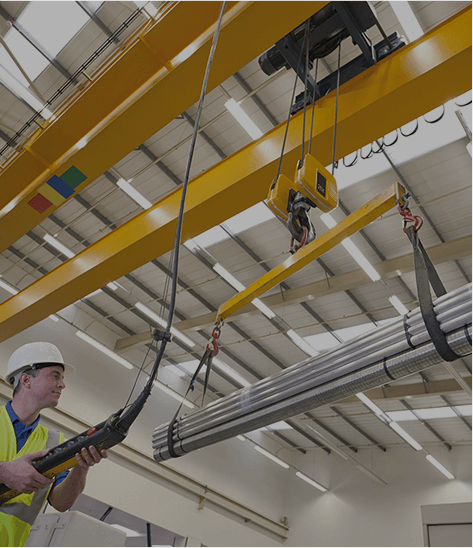
European-style single-girder overhead crane does not refer to a crane manufactured in Europe, but rather to a single-girder overhead crane designed and manufactured using European standards (especially German FEM and DIN standards).
The core concept is: while meeting the same safety regulations and performance requirements, through optimized structural design, the use of high-quality materials, and advanced processes, to achieve the lightest possible weight, lowest wheel pressure, lowest height, and lowest energy consumption, thereby maximizing overall economic benefits for the user.
Main Girder: Utilizes off-center box girder or high-strength rolled steel beams (such as I-beams or special section beams). Through finite element analysis optimization, while ensuring strength and rigidity, the cross-section is smaller, and the weight is 30%-50% lighter than traditional single-girder overhead crane .
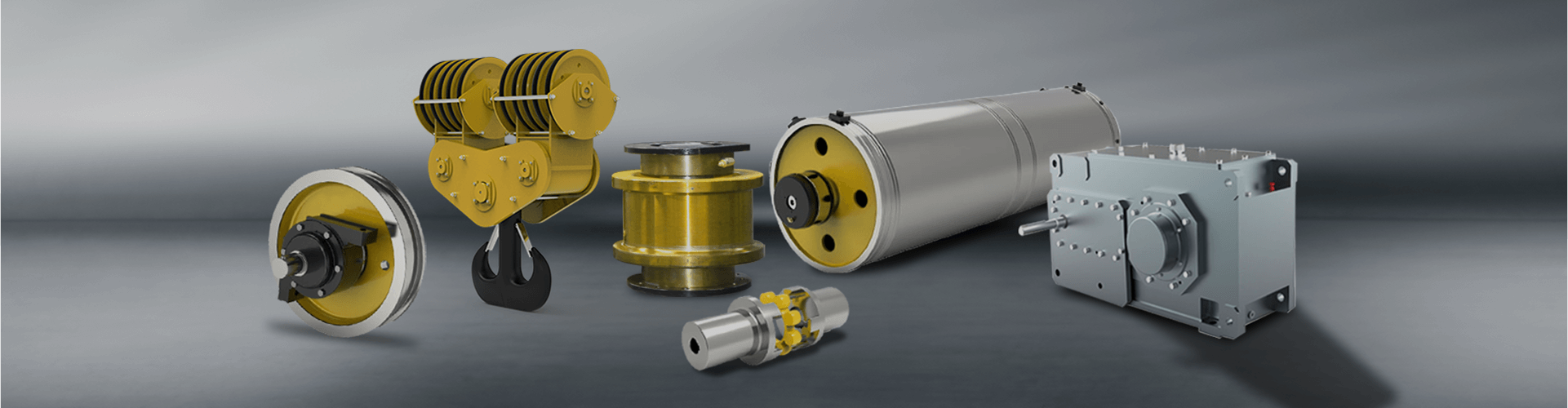
End Beams: Typically a three-in-one structure (integrating the reducer, brake, and motor into one unit), resulting in a compact structure and light weight.
The hoisting mechanism (often a low-headroom
wire rope electric hoist) is tightly integrated with the main girder, allowing the hook to be closer to the main girder at its extreme positions.
Why Choose a European-Style Single-Girder Bridge Crane?
I. Directly Visible Core Advantages
Significant Savings in Factory Construction and Energy Costs
Reduced Factory Height: Its low headroom design reduces the crane's own height for the same lifting height. For new factories, this directly reduces the factory height (approximately 1-2 meters), significantly reducing initial investment and long-term energy consumption in civil engineering, steel structures, lighting, and heating/cooling.
Reduced Wheel Pressure and Load Capacity: Lighter weight means less wheel pressure on the factory's track beams and columns. For existing factory renovations, it can be used directly or requires only minor reinforcement; for new factories, it reduces the amount of steel used in the supporting structure, further saving costs.
Energy Saving: Lightweight structure and efficient drive systems (such as frequency converters and "three-in-one" motors) result in low operating resistance and energy consumption approximately 30% lower than traditional cranes, leading to considerable long-term electricity savings.
Superior Performance and Operation Experience
Smooth Operation and Precise Positioning: Widely uses variable frequency stepless speed regulation, ensuring smooth start and stop, and achieving millimeter-level precise positioning. This is crucial for scenarios involving precision assembly, machining, and automated production line integration.
Extremely High Reliability: Modular design, high-quality core components (German or equivalent brands), and stringent manufacturing processes ensure an extremely low failure rate and a long service life.
User-Friendly Operation: Standard wireless remote control allows operators to operate from the optimal ground view, ensuring safety and efficiency. The driver's cab (optional) is spacious, offers excellent visibility, and minimizes vibration and noise.
Maximized Space Utilization
Greater Effective Lifting Height: Replacing existing factory buildings with European-style cranes frees up more vertical space for increasing lifting height or storing higher shelving.
Smaller Minimal Interference: The compact design allows the crane to be positioned closer to walls at the factory's ends and sides, minimizing blind spots and maximizing workshop space utilization.
II. Long-Term, Hidden Key Benefits: Extremely Low Maintenance Costs and High Availability
Modular Design: Major components (such as drive units and electrical controls) are standardized modules, allowing for rapid diagnosis and complete replacement in case of failure, minimizing downtime and ensuring production continuity.
Long Maintenance Cycles: High-quality components and precision manufacturing mean longer maintenance intervals and fewer repair needs. Fully sealed bearings and lubrication-free designs reduce daily maintenance workload.
High Availability: Low overall failure rate and quick repair results in a significantly higher Overall Equipment Effectiveness (OEE) than traditional equipment, reducing production downtime losses due to crane failures.
Excellent Adaptability and Expandability
Perfectly Adaptable to Automation: Smooth and precise operation, abundant sensor interfaces (position, anti-sway, anti-collision), and communication protocols (such as Profibus) allow for easy integration into smart factories (Industry 4.0) and automated logistics systems.
Flexible Function Expansion: Advanced functions such as intelligent anti-sway systems, precise positioning systems, automatic weighing, and remote monitoring can be easily added as needed.
Higher Safety Standards and Compliance
Complies with the most stringent international safety standards (such as FEM/ISO) and features comprehensive safety devices (dual limit switches, overload protection, emergency braking, etc.).
Design life is typically over 25 years, ensuring safe and stable operation throughout its entire lifespan.
When Should You Choose a European Single-Girder Crane?
In the following scenarios, the return on investment (ROI) of European-style single-girder bridge cranes is particularly outstanding:
New factory buildings or production lines: Adopting them from the design stage maximizes savings in civil engineering and energy costs.
Factory buildings with limited height or requiring maximum space: Renovating old factories or situations with high space rental costs.
Requirements for stable operation and positioning accuracy: Such as precision manufacturing, automotive assembly, aerospace, and mold workshops.
High usage frequency (Operating class A4 and above): High-intensity production rhythms require high equipment reliability and low failure rates.
Planning future automation upgrades: Reserving interfaces for smart factory layouts.
Emphasis on total lifecycle cost (TCO): Decision-makers not only look at the purchase price but also focus on the comprehensive costs of energy consumption, maintenance, and downtime losses over the next 10-20 years.
In summary, choosing a European-style single-girder bridge crane is not choosing a more expensive piece of equipment, but rather choosing a more efficient, economical, and intelligent "production partner" and "logistics solution." It shifts costs from upfront procurement to long-term value, typically recovering the price difference compared to traditional equipment within 3-5 years through savings in infrastructure, energy, maintenance, and increased productivity, and continuing to generate net profits in subsequent years.
In short: If your goal is to reduce total long-term operating costs, improve productivity, and prepare for the future, then European-style cranes are a clear technical and economic choice.